SECRET SOCIETIES AND THEIR HIDDEN HISTORY

Unlocking the door to the mystery behind one of the most astonishing secret societies. There are numerous influential and powerful secret societies, such as The Illuminati, meaning “those who have been enlightened,” according to John Greer’s “The Element Encyclopedia of Secret Societies and Hidden History.” There has been confusion between a few other societies, according to conspiracy theorists. Here is another secret society, the Skull and Bones Society, that emanated from Germany and was incorporated into a fraternity at Yale University. Its members included a handful who became presidents, for example, George H.W Bush and William Howard Taft. However, their numbers measure up poorly compared to presidents who have been Freemasons, as there were 15 of them; there is George Washington, James Monroe, Andrew Jackson, James A. Polk, James Buchanan, Andrew Johnson, James A. Garfield, William McKinley, Theodore Roosevelt, William Howard Taft, Warren G. Harding, Franklin D. Roosevelt, Harry S. Truman, Gerald Ford, and Lyndon B. Johnson. We are delving into one of the most powerful worldwide societies of Freemasonry, the "Scottish" Masonry, more specifically, the Ancient and Accepted Scottish Rite of Freemasonry (AASR).
Their history, origins, and legends go back to the founding of the Holy Land in the era of the Crusades. That does not mean that they are of Scottish descent. The Scottish Rite's rituals originated in France, and by the 1830's it reached Scotland. In fact, it was traced to 1833 when they were imported from America, which was connected to the Jacobites. When we look further back in time to 1736, this was the first time that an affiliation of the craft was traced to the knightly orders of the Crusades, a claim made by Andrew Michael Ramsay, a Jacobite.
Turmoil began spreading, and the questioning of the legitimacy of a certain regime began. The British Army made an advance, which caused the Jacobites to retreat to Scotland. Commendation to France and Sweden with Masonic networks who intervened and helped support the Jacobites who barely made it to Scotland with their lives. Hence, in 1754, the Templar grades' secret was uncovered, the knowledge became public, and the Rite of Perfection was founded in Paris.
(The Element Encyclopedia of Secret Societies and Hidden History)
HOW AND WHO FACILITATED THE EVOLUTION OF THE AASR?
The Freemasons’ coveted hidden history captivates and holds mystery still to this day, with a guarantee to continue past the end of time. There is also a level of respect and intellect that remains as if written in stone, no pun intended. What or who is the catalyst for the creation of the most influential and worldwide societies? Let's take an even closer look back in time at the bodies of Freemasonry and how they grew. Originated in France in the 1700's, a charter in Charleston, South Carolina, was obtained by a group of Freemasons in 1802 to work the Rite of Perfection. Knowing their lineage to the Knights Templars, the most recognized powerful worldwide Masonic entities, was founded as the Ancient and Accepted Scottish Rite. It emanated from the United States concordant bodies of Freemasonry. Now we have made the connection from America to the mystery of the development of the Rites in American Freemasonry. There are two jurisdictions, the Northern and the Southern.
Now, we come back to the catalyst for this incredible evolution that turned the Scottish Rite into one of the world's most renowned and successful Masonic rites, Albert Pike. He joined the Scottish Rite in 1853 and soared rapidly through the ranks. By 1859, Albert Pike became the Grand Commander of the Southern Jurisdiction. This incredible man was the key that formed the Scottish Rite, which is still known to this day.
ANCIENT AND ACCEPTED SCOTTISH RITE OF FREEMASONRY (AASR) AND THE CONNECTION TO THE CHICAGO AREA
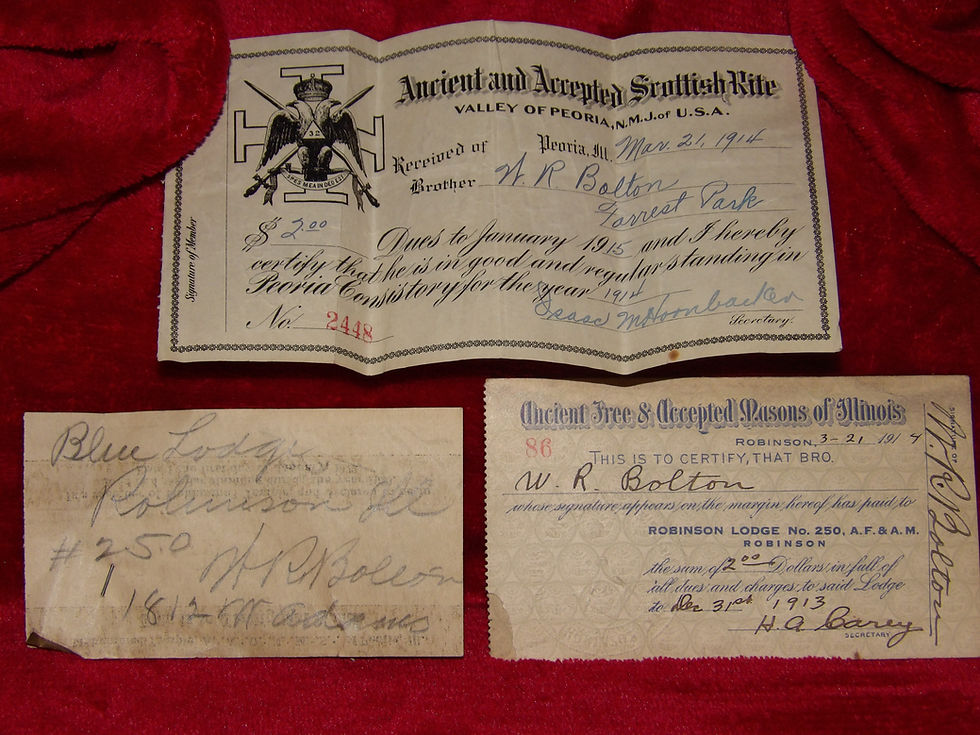
The certificate featured is for William Richardson Bolton from the Supreme Council Of S ∴ G Inspectors General 33 Of The A ∴ A Scottish Rite for the Northern Masonic Jurisdiction of the United States of America sitting at its Grand East Boston, Massachusetts, that certifies him as a Prince of The Royal Secret 32°and as such is regularly affiliated in our Consistory in the Valley of Peoria in the state of Illinois and is hereby recommended to the protection and the fraternal consideration of all members of the Ancient Accepted Scottish Rite throughout the world.
(document featured)

This is written with the utmost pride to connect the dots to our Chicago area! The fez featured is William Richardson Bolton’s, worn previously by John A. Bush, who was a respected businessman and dedicated Freemason in Peoria, Illinois. The fez holds a special and significant piece of local Masonic history. The symbol is from the Mohammed Shrine Center in Bartonville, Illinois, which serves the heart of the Illinois region stretching throughout central Illinois from the Iowa to Indiana borders. The Mohammed Temple was originally formed in 1893. The emblem represents a scimitar suspended from a crescent moon featuring a sphinx head and a five-pointed star, and as you can see by the certificate featured, William Richardson Bolton kept climbing the ranks higher and higher to one of the highest titles one can achieve!
In Central Illinois, the Valley of Peoria Scottish Rite and the Mohammed Temple Shriners were historically inseparable. Beyond just sharing architectural spaces, these two organizations collaborated on major community festivals and served as the primary drivers of Peoria's civic and benevolent growth. Chicago, stand with pride!

THE MEANING OF THE SYMBOL WITH THE THREE DOTS
The usage of the number was in approximately 1764, but the documentation was in France in 1774. The number three is very significant to Freemasonry, which is also a symbol in connection to the triangle. It is said that the three dots are a representation of the lights around the altar. They are used after certain letters, for example, the letter L for Lodge or FF for brother, indicating technical terms or initials for Masonic titles.
WHAT IS A TRESTLEBOARD?
When applied to Masonic practices of new and old, trestleboards are diagrams containing every important symbol pertaining to each of the degrees of Craft Masonry. Original boards were heavy, made of wood, and held by trestles placed at job sites. The master mason, who would be leading the building projects, drew measurements, designs, and proportions with chalk or charcoal or placed blueprints on it to help other masons get the jobs done. Newer boards are permanently placed in the high mason's office and are called tracing boards, still displaying the same original diagrams and symbols of the Masonic degrees. Masonic lodges still use a version of the original trestleboard, but instead use it as their monthly member newsletter or bulletin, telling the craftsmen about work that still needs to be completed. Both boards have been and still are used as teaching mechanisms and visual aids when teaching new members the rules of Freemasonry.
THE BLUE LODGE
The Blue Lodge, otherwise known as the Ancient Craft Lodge and the Symbolic Lodge, is the foundational body of Freemasonry. Other parts of Masonry are not accessible until one has obtained the three degrees of the Symbolic Rite.
A master, two wardens, and a group of officers handle responsibilities and govern the Symbolic Lodge. Typically, lodges hold meetings once or twice per month, but that can vary according to circumstances.
The Lodge card and documents featured are William Richardson Bolton's.
If you are seeking a family member who is affiliated, you can find records in the Peoria Scottish Rite Valley archives by contacting them directly.
Secret Societies and their hidden history will forever captivate, but the most important Masonic body, the Ancient and Accepted Scottish Rite, still holds the worldwide legacy to this day.
Author: Kimberly Bolton Bryan


Comments